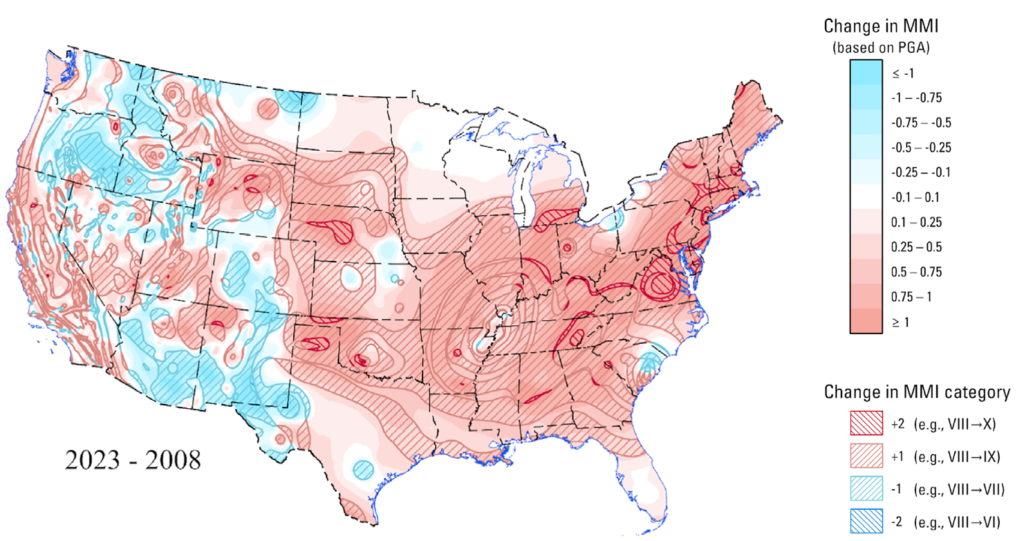
A peer‑reviewed study was recently published in Earthquake Spectra titled “Evaluating the U.S. Geological Survey’s Earthquake Shaking Hazard Forecasts and Their Implications on Seismic Risk.” This publication reflects scientific research conducted by Dr. Kishor Jaiswal, Dr. Mark Petersen, Dr. Arthur Frankel, Kenneth Rukstales, Allison Shumway, and Dr. Peter Powers of U.S. Geological Survey (USGS), as well as Dr. N. Simon Kwong and Dr. Robert Chase, both presently at Lettis Consultants International (LCI). The research does not imply endorsement of any private organization or commercial product. The full journal publication can be found here, and its abstract is provided below:
“We analyze the last six update cycles of the long-term probabilistic earthquake shaking hazard forecast from the U.S. Geological Survey (USGS) and discuss the changes in hazard estimates from the 1996 to the latest 2023 update of the National Seismic Hazard Model (NSHM) for the conterminous United States. We summarize how our understanding of earthquake hazards has evolved over the last two decades and quantify the implications of changing hazards on people, buildings, and lifeline infrastructure. The net effect of changes in hazard estimates, with reference to the mean hazard from the 2023 NSHM update that has 2% probability of exceedance in 50 years, suggests an overall increase in total geographic areas facing very strong shaking levels (modified Mercalli Intensity (MMI) of VII or more) when compared with any of the previous cycles. This increase puts ~159.2 million people (an increase from 111.8 million when using the 2018 NSHM),~47.3 million residential buildings (an increase from 32.5 million with the 2018 NSHM), and ~$25.6 trillion of economic exposure of all buildings (an increase from $17.4 trillion when using the 2018 NSHM) at risk from earthquakes. We demonstrate that small changes in hazard estimates do not necessarily imply small changes in risk estimates. Therefore, changes in risk estimates can be used to highlight key USGS NSHM updates for improving risk mitigation efforts.”